Although our house still has that empty feeling and we are still awaiting the first batch of our stuff, which should arrive this week, I’ve been feeling a lot more plugged in to information this week.
Why is that? you ask. One thing we’ve had for several days, of course, is the DSL hookup. (You didn’t think we were uploading this stuff on dial-up, did you?) I’ve started exploring podcasts a little bit – mainly because it’s a way for me to listen to a story or two from, say, yesterday’s PBS News Hour while I eat lunch or do something else around the house even after I disconnect from the internet and leave the fourth floor. I’m also back to trying to keep updated on the news from the States by keeping one or two front-page stories from the New York Times (from the night before, since it’s already tomorrow in Vladivostok when I check in) up on my computer desktop. The trick is obviously then to find the time to read them in the course of the day, and even that happens from time to time.
An even more (unexpectedly) exciting change is that, thanks to a very unusual type of Cable Guy, we’ve got our American “Armed Forces Network” (AFN) TV cable working. Last week, I was told that a guy named Yurii would be coming at about 10 on Tuesday morning. When he didn’t show up until about noon, I wasn’t very surprised. In fact, I thought that was pretty good, judging by American service-call standards. But, for whatever reason, I didn’t expect a cable repairman to look like a rock band promoter, or maybe even a hipster drug dealer. No offense to rock band promoters, but I’m kind of trying a few things on for size, since I’m actually not quite sure what his get-up signified in American style semiotics.
He wore sunglasses, was tan, kind of skinny and short, had on a leather jacket and tight grey colored jeans, and wore some kind of Euro-fashion, pointy leather shoes, I think, which of course he took off after entering the townhouse, in the Russian habit. I think he had a
soul patch or something, too. I can’t remember too well, and I was so taken aback by his appearance that I kind of forgot to mentally catalog what it was that was so striking about it. And funny, too, from the point of view of an American waiting for a “cable guy.” Frankly, he was kind of creepy, and that wasn’t helped by the fact that he insisted on speaking pretty rudimentary English to me in a heavy weird-sounding Russian accent, even after I gently let it become apparent that I spoke Russian better than that.
Anyway, Yurii had been called out to help us stop inadvertently stealing the AFN from our diplo-neighbors. As it was, every time we turned on the cable box, we threw the reception out for the townhouses to our left and our right. I think it was a frequency issue. In any case, Yurii changed the configuration and now it works.
Ironically, having the cable hookup means that we now get better TV than we have for a very long time. Since about fall 2004, if I remember correctly, when the cable company cut off the free hookup we had inherited when we first moved to Bethesda. Now we’re able to watch all sorts of network news shows (when it’s the next day here, of course) and Saturday Night Live, all with great reception. We also get the Daily Show and the Colbert Report, which is completely new. And we can even listen to NPR on the upper channels that have the AFN viewing schedule scrolling constantly. With all of that, we feel a lot more connected to the kinds of information we were used to getting back home.
I’ve also been enjoying the array of local Vladivostok newspapers that Dan brings home from his reporting section at work a few times a week. I always have fun in Russia trying to figure out not only what precisely the newspaper stories say but what the tone and leaning of a publication is. Not to mention that it helps you get ground just to learn more about what the reading public and journalists in the country and the locality are paying attention to.
Last week I was most interested in stories about the recently-elected Primorye regional parliament, and trying to figure out what the reports of that body’s antics during its initial meeting indicate about the local and regional political situation, who they indicate are the personalities to listen for, etc. Sounds like the regional party “United Russia” – Putin’s party – is, not surprisingly, the majority party with the clout to attract stragglers to its parliamentary faction. It’s also not clear who will populate the opposition and exactly what form this tiny group’s challenge to the “bears” of the Putin party will take.
Another story that caught my eye last week was the commentary on the lead-up to Russia’s November 4th holiday, the “Day of National Unity,” which was celebrated (? commemorated?) for only the second time this year. As foreign commentators have mentioned of late, it’s a good indication of what a delicate balancing act the government is engaged in with burgeoning nationalist elements when it decides to create a holiday of this sort. And then has to deal with the fallout as the public gives its varied interpretations of what a celebration of “national unity” should look like. Last year, perhaps most noticeably in Moscow, the holiday was marked by
public skinhead rallies.
Last week, Vlad’s newspapers were abuzz reporting on acts of “hooliganism” that took place late one night on the city’s prominent embankment that leads out onto the Amur Gulf (where we took our stroll last Sunday afternoon) and an incident of vandalism in which swastikas were found spray-painted on the city’s synagogue. Organized nationalist groups in town disavowed the actions (insisting helpfully instead that they would have beat up a few Chinese or Korean laborers if they had wanted to make a statement). Journalists wondered whether there was a connection between the vandals’ activities and the “Russian March” demonstration planned for the morning of November 4 by the local chapter of Dvizhenie protiv nelegal’noi immigratsii (Movement Against Illegal Immigration). Since Dan actually observed the first half hour of the march, I’ll let him comment on it directly (very briefly, so as not to keep you in complete suspense: it was pretty much a bust, thankfully).
But I found myself wishing I had the freedom to get out more and talk to local people about these issues, to see what comment they might have on the holiday in general and these incidents and the march specifically, and to write something about what I might learn. Obviously, it’s possible in principle for me to do these things, but in practice I don’t feel like it’s very much within my reach right now. I think what I’m trying to say is that, despite the disturbing significance of these news stories, I was glad to find I had a real personal engagement in the issues I was reading about, and that I even sensed the potential for these unfortunate tendencies in contemporary Russian society to inspire me to get out and pick up again the work of investigating the elements of a story and then telling that story to a reading audience. All of which leads back to the mundane things that keep this stuff a daydream for now and reminds me that I still need to get our babysitter situation sorted out and gain some time for myself to pursue either this kind of journalistic project or my historical research, or both.
And speaking of babysitting, last but not least among the connections established recently between us and the outside world lies at the intersection of the media and the munchkin: Anya has begun starring in video of more than one kind.
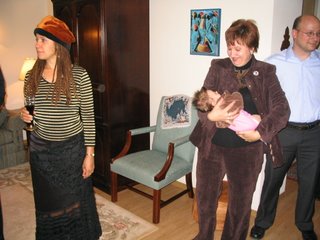
Locally, she was spotted on Vladivostok network TV in some footage shot at the consulate reception welcoming American jazz vocalist Arlee Leonard to town one evening during our first week here. (At right is a photo of Arlee, Anya, Svetlana from the TV station, and Dan.) I have yet to see the tape, but evidently they showed a portion of Ms. Leonard’s impromptu concert that night, over which the commentator quips that “even two-month-old Anya, the youngest member of the American diplomatic corps, understood the importance of the occasion and kept quiet out of respect for the performer.” (It’s nice to see that Russian television journalism continues to take serious editorial license, even in regard to our daughter.)
Anya’s also seen her debut on the global media stage. In an attempt to give her grandparents and other interested parties even more lifelike updates on the kid than still photos can provide, I’ve started uploading some short videos of her onto
YouTube. I know, it’s crazy, but I just can’t resist the temptation of all of these geeky/trendy web things when they can be helpful bridging the distance now that we are so far away.


